
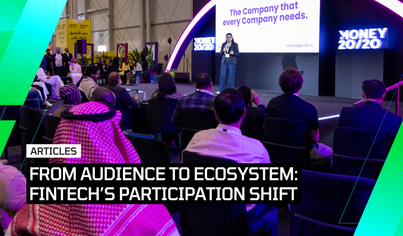
From audience to ecosystem: fintech’s participation shift
Fintech is shifting from access to participation. Find out why ecosystems (not audiences) will define the next phase of growth in MENA and beyond.

Walk through the Dubai International Finance Centre (DIFC) or Riyadh’s King Abdullah Financial District today and you can feel it: the energy has shifted. Instead of just asking what AI can do for us, there’s a new focus on how we can scale this shift without setting our financial system on fire.
And it started with the regulators – because they’re highly engaged and focused on building a positive financial future by working with AI, instead of against it.
Take Dubai. When the Dubai Financial Services Authority (DFSA) released its 2025 AI survey, the headline number made waves: AI adoption among DIFC firms jumped from 33% to 52% in one year, and generative AI usage surged 166%. But beyond the enthusiasm, the really interesting part was the caution. Many firms admitted they were still using AI internally, not customer-facing, because they wanted clearer regulatory guidance on governance and accountability.
At almost the same time, the DFSA published a paper on cybersecurity, AI and quantum risks – reminding us that for GCC regulators like the DFSA, AI is treated as a new category of risk that demands supervisory muscle.
Instead of just adopting AI, the UAE is actively supervising it.
Riyadh’s approach is even more explicit. The Saudi Central Bank (SAMA) regulatory sandbox is a structured, staged, regulator-in-the-room testing environment. Each fintech gets limits on scale, customer exposure, and risk – and they can only graduate to full authorisation after they’ve proved safety.
SAMA regularly adds new fintechs to the sandbox (including several early in 2025), showing that it’s actively managing AI-linked innovation, rather than letting it drift.
This is why banks like Bank Albilad have been rolling out AI-powered fraud detection systems in ways that meet SAMA’s AML and risk requirements. In the region, we know AI can drive greater efficiency; but there’s also a heavy focus on compliance by design.
And Saudi Arabia’s fintech expansion is tightly bound to this model. As the country accelerates open banking and digital finance, the sandbox and regulatory commitments are explicitly framed as the stabilisers that keep AI-fuelled growth safe.
The UAE’s capital adds another dimension: AI for regulators themselves.
Abu Dhabi Global Market’s FSRA published a study exploring how AI can strengthen regulatory oversight, market integrity, and compliance monitoring – especially in virtual asset markets where data is messy and risk is high. Importantly, this wasn’t a vendor whitepaper; it was co-authored with the ADGM Academy Research Centre and NUS’s Asian Institute of Digital Finance, enabling serious policy depth.
Pair that with ADGM’s forensic analysis of 1,800+ crypto hacking events over a decade, and you see a regulator building the data backbone required for AI-driven supervision.
Together, Dubai, Riyadh, and Abu Dhabi demonstrate a region where regulators are embracing AI as both a tool and a risk, and building supervisory scaffolding early enough to really make a difference.
No GCC regulator is yet writing rules specifically for autonomous financial agents – the kind of AI that executes actions, not just predictions. But the groundwork is being laid.
In lending, vendors are already pitching ‘agentic credit decisioning’ systems to Gulf banks – AI that pulls data, analyses risk, proposes decisions and adapts in real time. It’s still early, often starting as proof of concept or targeted deployments rather than full-scale replacements; but the region is a natural home for this: centralised data, unified infrastructure, and regulators who like to keep new tech on a short leash.
And while there’s no global league table that crowns the region as ‘most compliant’, research such as this paper on the construction of a GCC-specific AI adoption index shows that regulation and infrastructure are the strongest drivers of AI maturity in the region – even though progress varies country to country.
None of these countries are trying to out-innovate Silicon Valley. Instead, the region is trying to build something Silicon Valley hasn’t yet attempted: a high-trust, supervisor-friendly AI ecosystem where financial innovation can happen fast, without breaking things.
And for the region? It means the Middle East could become the world’s proving ground for compliant AI in finance; not because it moves the fastest, but because it moves the safest.
Fintech is shifting from access to participation. Find out why ecosystems (not audiences) will define the next phase of growth in MENA and beyond.

Find out how Money20/20 Middle East is supporting Saudi Arabia’s fintech growth, accelerating Vision 2030 ambitions and aligning regulators, banks, startups and investors.
Fintech is shifting from access to participation. Find out why ecosystems (not audiences) will define the next phase of growth in MENA and beyond.
Find out how Money20/20 Middle East is supporting Saudi Arabia’s fintech growth, accelerating Vision 2030 ambitions and aligning regulators, banks, startups and investors.