
Fintechs don’t scale alone
How fintech companies scale: why ecosystems, partnerships, and investor networks matter more than product alone in driving growth and funding.
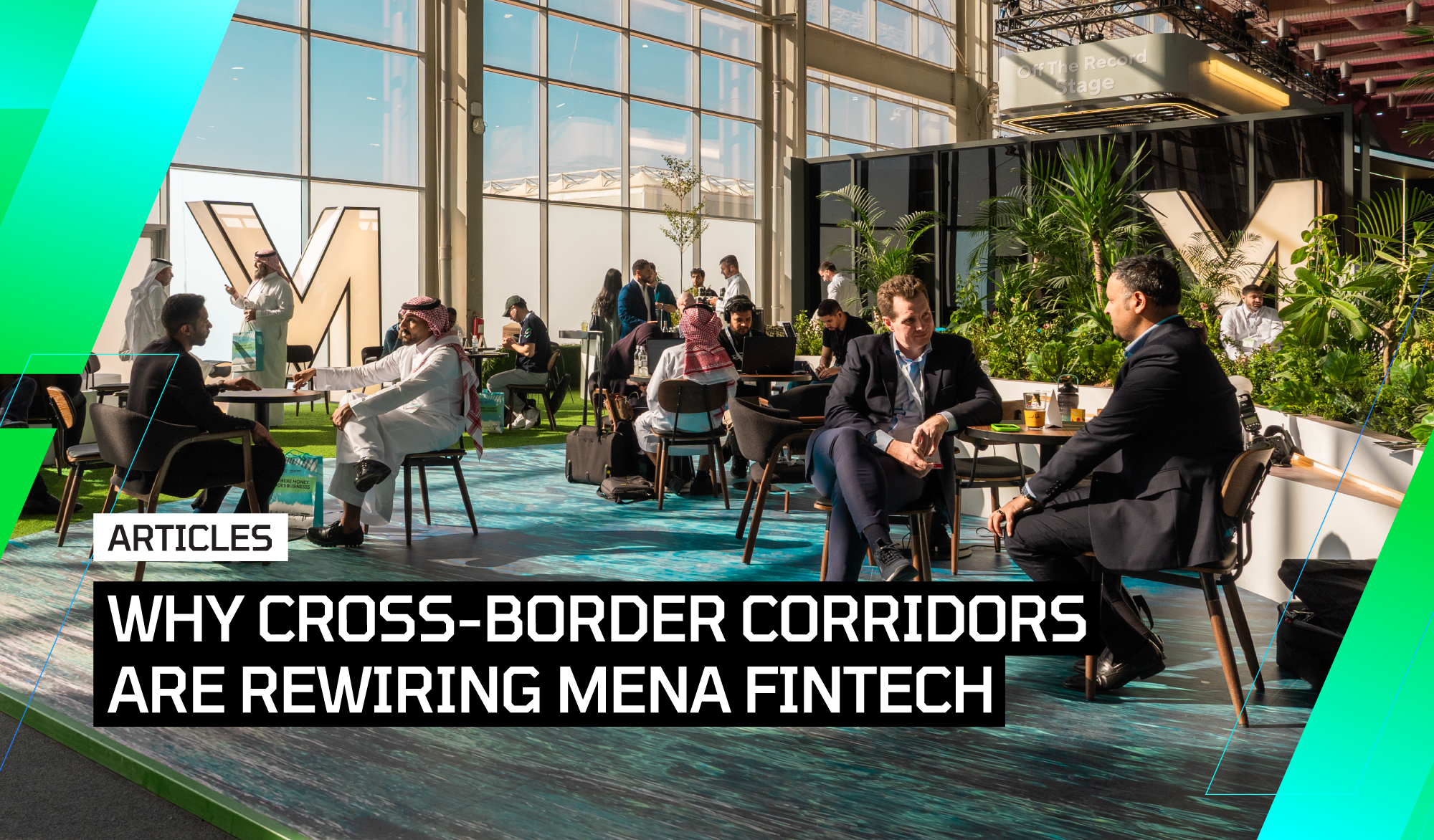
Fintech capital has always chased ideas. At Money20/20 Middle East, we love that energy – founders with the drive to create better systems and better financial opportunities through tech, and investors willing to make it possible.
Ideas are still the lifeblood of the sector. But in 2026, capital is chasing corridors. Instead of only solving local problems, fintech startups in MENA are designing products for cross-border flows where capital, people and payments intersect.
The international push to fix cross-border payments hasn’t yet translated into meaningful improvements for end-users at the global level, as noted by the Financial Stability Board (FSB).
And the targets remain steep. The BIS summarises the G20’s quantitative goals, including reducing the global average cost of a retail cross-border payment to no more than 1% (by the end of 2027) and achieving 75% of cross-border payments credited within one hour (with the remainder within one business day). The same BIS Bulletin notes that it’s unlikely the end-2027 targets will be achieved on time, and that improvements so far have been modest.
In plain language, that means the plumbing isn’t fully built yet – and where it does work, value flows faster.
Capital follows flows, and the Asia-GCC corridor is hard to ignore. In October 2025, DBS and Banque Saudi Fransi announced a partnership to strengthen trade finance and payment flows between Asia and the GCC. Reuters reported that trade between Southeast Asia and the GCC reached USD $130.7 billion in 2023, with DBS projecting an additional $50 billion in trade flows by 2027. The same report cited a projection that trade between China and GCC countries could double to $1.9 trillion by 2035.
For fintech founders and investors, this is the point: when trade and payments corridors deepen, startups can scale revenue across multiple markets – and investors can underwrite growth with clearer, corridor-driven demand.
Remittances are among the most durable cross-border flows. The World Bank notes that in 2023, remittance flows to low and middle-income countries reached $656 billion, surpassing foreign direct investment (FDI) and official development assistance (ODA). That durability enables product opportunities – from compliance and FX to payout networks and consumer financial services.
Large recipient markets are also concentrated. According to BBVA Research, India is the world’s largest remittance recipient, estimating $125 billion in 2023. For MENA fintechs, this is important because the GCC sits on major labour and diaspora corridors into South Asia and beyond – making ‘cross-border’ a business model, not a buzzword.
Investors still want credible paths to liquidity. A high-profile example is buy-now-pay-later app Tabby: Reuters reported that in February 2025 it raised $160 million at a $3.3 billion valuation, with its CEO saying the company was preparing for a stock market listing within 18 months.
Not everyone will IPO, of course. But the lesson here is that fintechs that demonstrate scalable, cross-border demand (and credible exit options) are more likely to command attention (and pricing) when capital gets selective.
Over the next year, MENA’s leading fintechs could increasingly double as the best corridor businesses: designed for cross-border flows, built to meet global payment expectations, and structured for the kinds of outcomes investors can actually underwrite.
How fintech companies scale: why ecosystems, partnerships, and investor networks matter more than product alone in driving growth and funding.
Fintech is shifting from access to participation. Find out why ecosystems (not audiences) will define the next phase of growth in MENA and beyond.
How fintech companies scale: why ecosystems, partnerships, and investor networks matter more than product alone in driving growth and funding.
Fintech is shifting from access to participation. Find out why ecosystems (not audiences) will define the next phase of growth in MENA and beyond.