
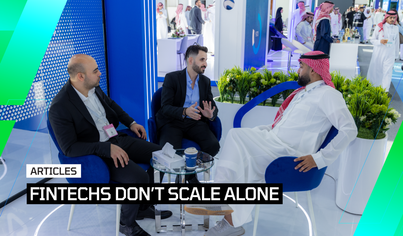
Fintechs don’t scale alone
How fintech companies scale: why ecosystems, partnerships, and investor networks matter more than product alone in driving growth and funding.

On payday, a young engineer in Riyadh does what many of us now do on autopilot. Salary in, bills paid, a slice moved into a savings account. Then her banking app flashes up something different – a mutual fund, a sukuk, a starter investment portfolio.
She thinks about it for a moment. Hesitates, and then taps away.
It’s not that she’s bad with money. The opposite, in fact. But when the conversation moves from saving to investing, her confidence evaporates. And she’s not alone.
New research suggests that Saudi Arabian citizens are getting plenty right. One 2022 study of 887 people, from the Faculty of Economics and Administration at King Abdulaziz University, found high financial literacy in budgeting, saving and debt, but only moderate literacy in investment and insurance. On a five-point scale, budgeting and saving scored just above 4 (‘high’), while investment and insurance sat closer to the mid-2s, pulling the overall literacy score down to a ‘moderate’ 3.5.
Among working adults, the picture looks bright at first glance. A 2024 survey of 1,127 Saudi Arabian professionals reported what the authors describe as ‘very good’ financial literacy – yet only about one-third (32.7%) answered all three core questions on interest, inflation and risk diversification correctly. Around 78% nailed the interest rate question, and 48% got inflation right. But when it came to risk diversification, only 11.3% answered correctly.
In other words, many citizens are confidently managing today’s money, but struggling to get a grasp on tomorrow’s wealth.
If basics like diversification feel fuzzy to working adults, it’s no surprise that younger citizens are even more exposed.
A 2024 youth-focused study points out that budgeting, saving, investing and debt management are largely absent from school and university curricula in the country. Citing data from the Saudi Central Bank, the authors note that only 12% of Saudi youth meet a basic financial literacy threshold – and they warn that this gap can translate into future debt stress and weaker credit profiles.
This reflects the broader global story. The OECD’s 2023 survey of adult financial literacy, covering 40 participating countries and economies, finds that only about 34% of adults reach a minimum literacy score of 70 out of 100. Adults with higher scores report better financial well-being and resilience – even after controlling for income and other socio-economic factors.
Saudi Arabia is a market racing ahead on digital payments, open banking, and retail investing. So this gap between access and understanding is becoming a strategic issue.
The nation’s policymakers are aware of the problem. The Financial Sector Development Program (FSDP), one of Vision 2030’s flagship programmes, is explicit about its goal: build a diversified, effective financial sector that stimulates savings, finance and investment, and transforms the Saudi Exchange into an advanced capital market.
Within that, a dedicated Financial Literacy Strategy, launched in 2019, aims to improve financial behaviours, alongside a National Savings Strategy.
And at the regional level, the Arab Monetary Fund frames financial education as a core pillar of financial inclusion – calling for coordinated national strategies and targeted programmes for youth, women and SMEs across the Arab world.
But research tells us that generic financial education isn’t enough. Demographic factors such as education level and field of study are strong predictors of literacy among working people in Saudi Arabia, while marital status or job sector matter much less.
The real bottleneck is education on advanced concepts – risk, time horizon, and diversification.
For banks, fintechs and regulators in Saudi Arabia and the wider Middle East, the next wave of innovation is about turning that paycheque pause into an ‘aha’ moment.
That means:
The region has already developed access to investing. The next challenge is to make sure people feel confident and informed enough to go for it.
For Vision 2030 to deliver a truly participatory financial system, MENA’s innovators need to focus on the messy middle – the space between ‘I can manage my paycheque’ and ‘I understand what it means to put my money at risk.’
That’s where the real inclusion (and the real opportunity) now lives.
This article is for information only and does not constitute investment advice.
How fintech companies scale: why ecosystems, partnerships, and investor networks matter more than product alone in driving growth and funding.
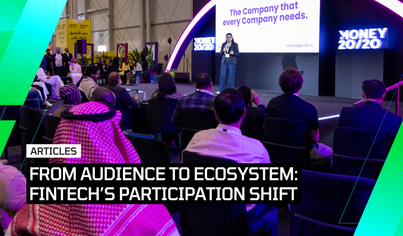
Fintech is shifting from access to participation. Find out why ecosystems (not audiences) will define the next phase of growth in MENA and beyond.
How fintech companies scale: why ecosystems, partnerships, and investor networks matter more than product alone in driving growth and funding.
Fintech is shifting from access to participation. Find out why ecosystems (not audiences) will define the next phase of growth in MENA and beyond.