
From audience to ecosystem: fintech’s participation shift
Fintech is shifting from access to participation. Find out why ecosystems (not audiences) will define the next phase of growth in MENA and beyond.
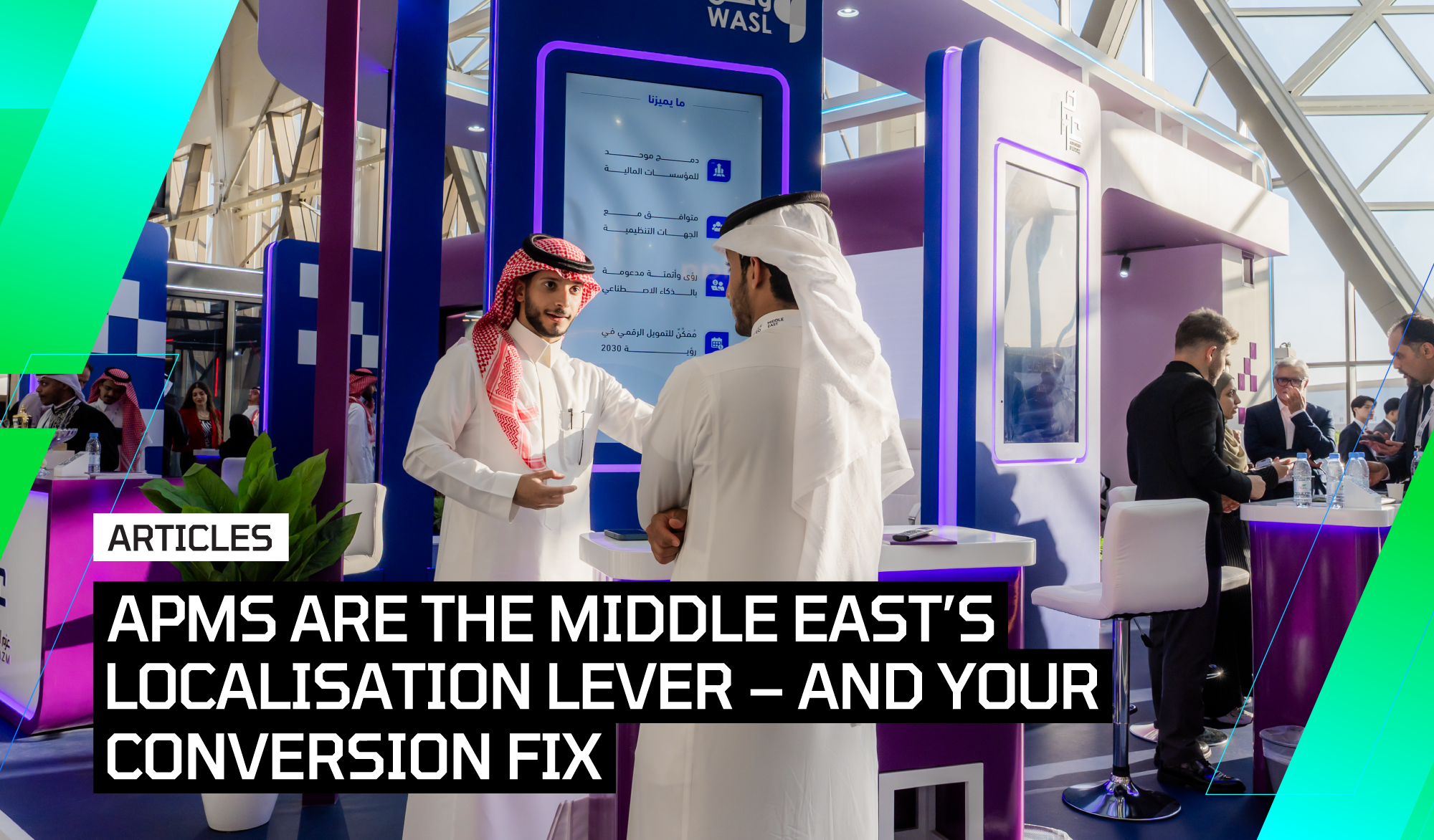
You can feel it in the split second before someone taps ‘Pay’. If the checkout doesn’t look familiar (the right wallet, the right domestic scheme, the right flow) shoppers don’t sit there and argue with your UX. They just leave.
And in the Middle East, that ‘right flow’ is increasingly linked to alternative payment methods (APMs) – even if the label is now a bit of a misnomer.
Checkout.com’s 2025 report on the state of digital commerce in MENA makes the point very clear.
In the UAE, the most preferred payment method isn’t a card at all. Global digital wallets lead at 37%, ahead of credit cards (32%) and debit cards (28%).
Saudi Arabia leans even harder into localisation. Alongside global wallets (34%), shoppers name Mada (22%) and stc pay (12%) as preferred methods – well ahead of international credit cards (18%).
And Egypt tells a different story again: cards still dominate, but local infrastructure matters. Fawry accounts for 18% of stated preference, sitting alongside global wallets (20%) and credit cards (33%).
Same region, but three different sets of checkout expectations.
This is why one-size-fits-all payment stacks underperform in MENA – and why APMs are a key localisation layer, not an edge case.
Worldpay’s recent report on global payments reinforces the same reality from a transaction-value perspective.
The study found that in UAE e-commerce, credit cards still account for 34% of value, but digital wallets already represent 30%, with account-to-account payments at 12%.
In Saudi e-commerce, digital wallets are the leading payment method at 33%, followed by debit and prepaid cards (29%) and A2A payments (15%) – while credit cards drop to just 12%.
Rather than a shift in preference, this represents a shift in expectation. If a Saudi shopper expects a wallet-first or Mada-enabled flow and you push them into manual card entry, you’re telling them that this product wasn’t built with them in mind.
And globally, this direction of travel is locked in. Worldpay shows digital payments rising from 34% of global e-commerce value in 2014 to 66% in 2024, with 79% forecast by 2030. So ‘alternative’ is now mainstream.
The strongest evidence that this is structural (not just trend-chasing) is usage.
Checkout.com’s MENA report shows digital wallet usage for shopping at 80% in the UAE and 82% in Saudi Arabia, with Egypt at 65%. For general spending, wallet usage rises further: 88% in the UAE, 84% in Saudi, and 87% in Egypt.
This means consumers already trust wallets with their money. If they don’t see them at checkout, something feels off.
If we zoom out for a moment, we see that the commercial case for getting this right is only strengthening.
Mordor Intelligence estimates the Middle East and North Africa digital payments market at USD $248.35 billion in 2025, growing to $420.38 bn by 2030 (that’s an 11.10% CAGR). Even more telling is that online and remote payments are forecast to grow at 14.6% CAGR through 2030, outpacing point-of-sale growth.
That’s where APMs (we’re talking wallets, domestic schemes, A2A) do their best work.
If you’re operating in the Middle East, APMs are a conversion strategy.
Localisation here means:
At Money20/20 Middle East, the smartest operators are asking how payments can become a local advantage.
Fintech is shifting from access to participation. Find out why ecosystems (not audiences) will define the next phase of growth in MENA and beyond.
Find out how Money20/20 Middle East is supporting Saudi Arabia’s fintech growth, accelerating Vision 2030 ambitions and aligning regulators, banks, startups and investors.
Fintech is shifting from access to participation. Find out why ecosystems (not audiences) will define the next phase of growth in MENA and beyond.
Find out how Money20/20 Middle East is supporting Saudi Arabia’s fintech growth, accelerating Vision 2030 ambitions and aligning regulators, banks, startups and investors.