
Money20/20 Middle East: where Saudi fintech strategy becomes reality
Find out how Money20/20 Middle East is supporting Saudi Arabia’s fintech growth, accelerating Vision 2030 ambitions and aligning regulators, banks, startups and investors.
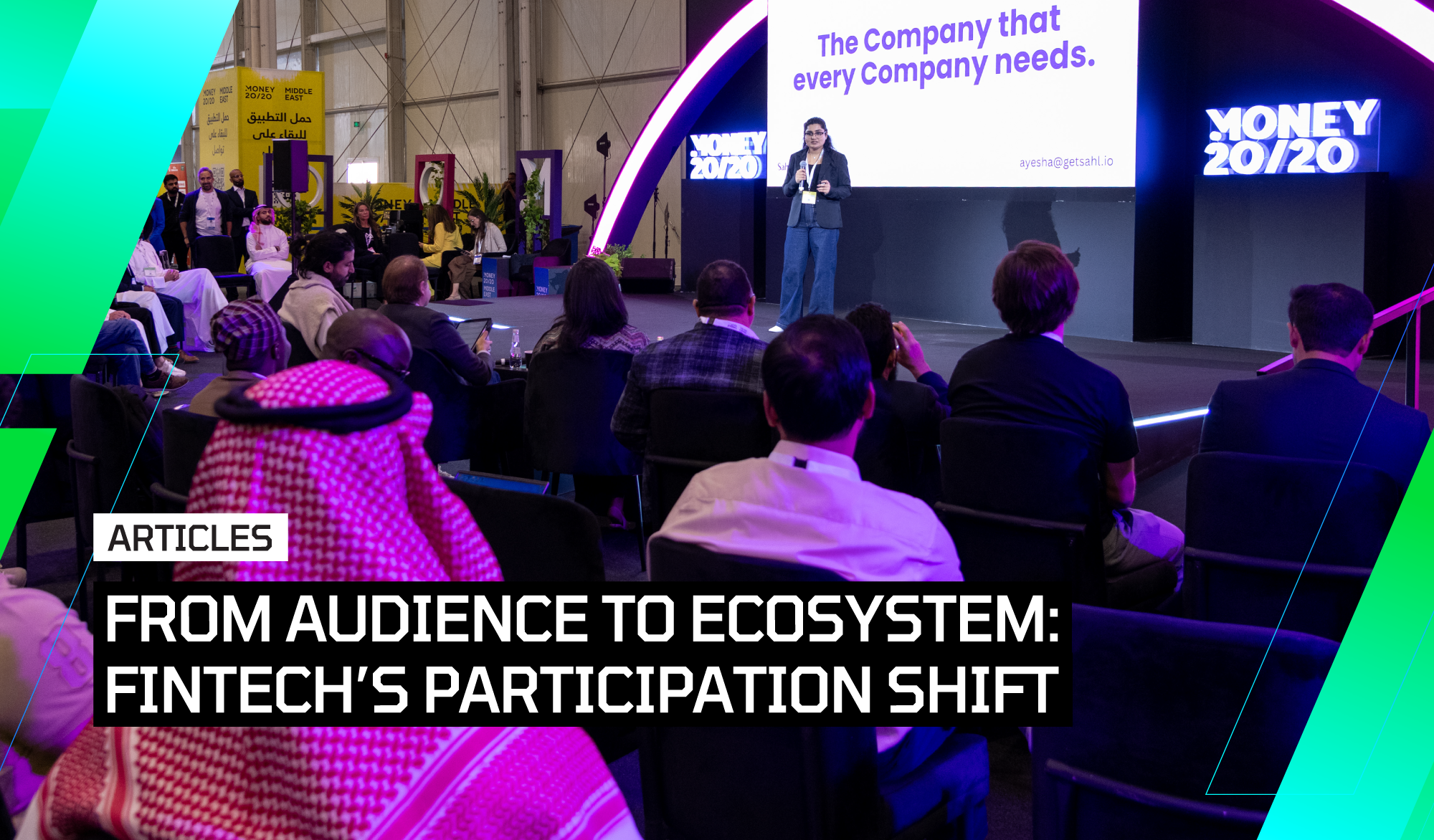
If the sector was still measuring progress in terms of access numbers (more accounts, more users, more infrastructure), you could argue that fintech has already won. But we’re seeing a new focus emerging now – a shift from access to participation.
Because having a seat at the table is one thing. Being able to influence what happens next is another.
The latest World Bank Global Findex data shows that 79% of adults globally had a financial account in 2024, up from 74% in 2021 and 51% in 2011. Half of those accounts are now digitally enabled.
But underneath that, much of the growth has been driven by digital payments and mobile connectivity, particularly across emerging markets. This means people aren’t just entering the financial system – they’re entering it through platforms that are inherently connected, data-rich, and real-time.
We know there are still access issues to overcome, particularly for underserved areas and demographics. But increasingly, access alone is no longer the constraint. Meaningful participation is.
The same report shows how closely financial inclusion is now tied to connectivity. Eighty-six percent of adults worldwide own a mobile phone, and mobile technology has become one of the main ways people enter and use the financial system. Mobile money has helped drive account growth, particularly in low and middle-income economies, while digital payments and formal saving have both expanded.
People can have an account and still be distant from the decisions shaping products, policy, investment and scale. They can be counted in adoption metrics without being visible in the rooms where the industry moves.
On the supply side, the International Monetary Fund Financial Access Survey paints a parallel picture: financial infrastructure has expanded dramatically over the past two decades, across more than 160 economies.
But that infrastructure is changing shape.
Physical indicators like bank branches and ATMs aren’t the heart of it all anymore. The system is shifting toward digital delivery, embedded finance, and platform-based services. The pipes are there – but they don’t guarantee flow.
Because it’s interaction that truly creates value. The services might exist, but we have to ask whether the right people are in the room: building, funding, regulating, and using them together.
According to the World Bank’s Fintech and the Future of Finance report, the lines between financial institutions, technology firms, and regulators are increasingly blurred. Instead of happening in silos, innovation is now happening across networks.
And outcomes now depend on coordination.
Public and private actors are co-creating the system in real time. Policy is evolving alongside products. Capital is moving earlier, faster, and more globally. Talent is flowing across borders and sectors.
In this world, fintech stops being something you enter into as a user, and starts being something you participate in as a stakeholder.
This shift is hugely consequential in MENA. The region sits at the intersection of capital (GCC), scale (Egypt), and connectivity (cross-border corridors linking Africa, Asia, and Europe). It has the ingredients of a high-velocity fintech ecosystem. But velocity depends on density.
Bringing founders, regulators, investors, and operators into closer orbit accelerates deals, of course. But even more importantly, it accelerates understanding. It shortens feedback loops, and turns ambition into execution.
In emerging ecosystems especially, progress happens in clusters – when the right actors move together.
Fintech’s next phase will be defined by who gets to participate in shaping financial services.
That means:
The future of fintech will be built by ecosystems.
At Money20/20 Middle East, we’re proud to be a part of that. Register now to exhibit or attend in 2026.
Find out how Money20/20 Middle East is supporting Saudi Arabia’s fintech growth, accelerating Vision 2030 ambitions and aligning regulators, banks, startups and investors.
King Abdullah Financial District (KAFD) is emerging as the infrastructure behind Riyadh’s fintech rise – where capital, policy and talent converge.
Find out how Money20/20 Middle East is supporting Saudi Arabia’s fintech growth, accelerating Vision 2030 ambitions and aligning regulators, banks, startups and investors.
King Abdullah Financial District (KAFD) is emerging as the infrastructure behind Riyadh’s fintech rise – where capital, policy and talent converge.