
From audience to ecosystem: fintech’s participation shift
Fintech is shifting from access to participation. Find out why ecosystems (not audiences) will define the next phase of growth in MENA and beyond.
Replacing core banking systems has become shorthand for transformation. But age doesn’t automatically mean a system isn’t good enough – the real constraint is rigidity.
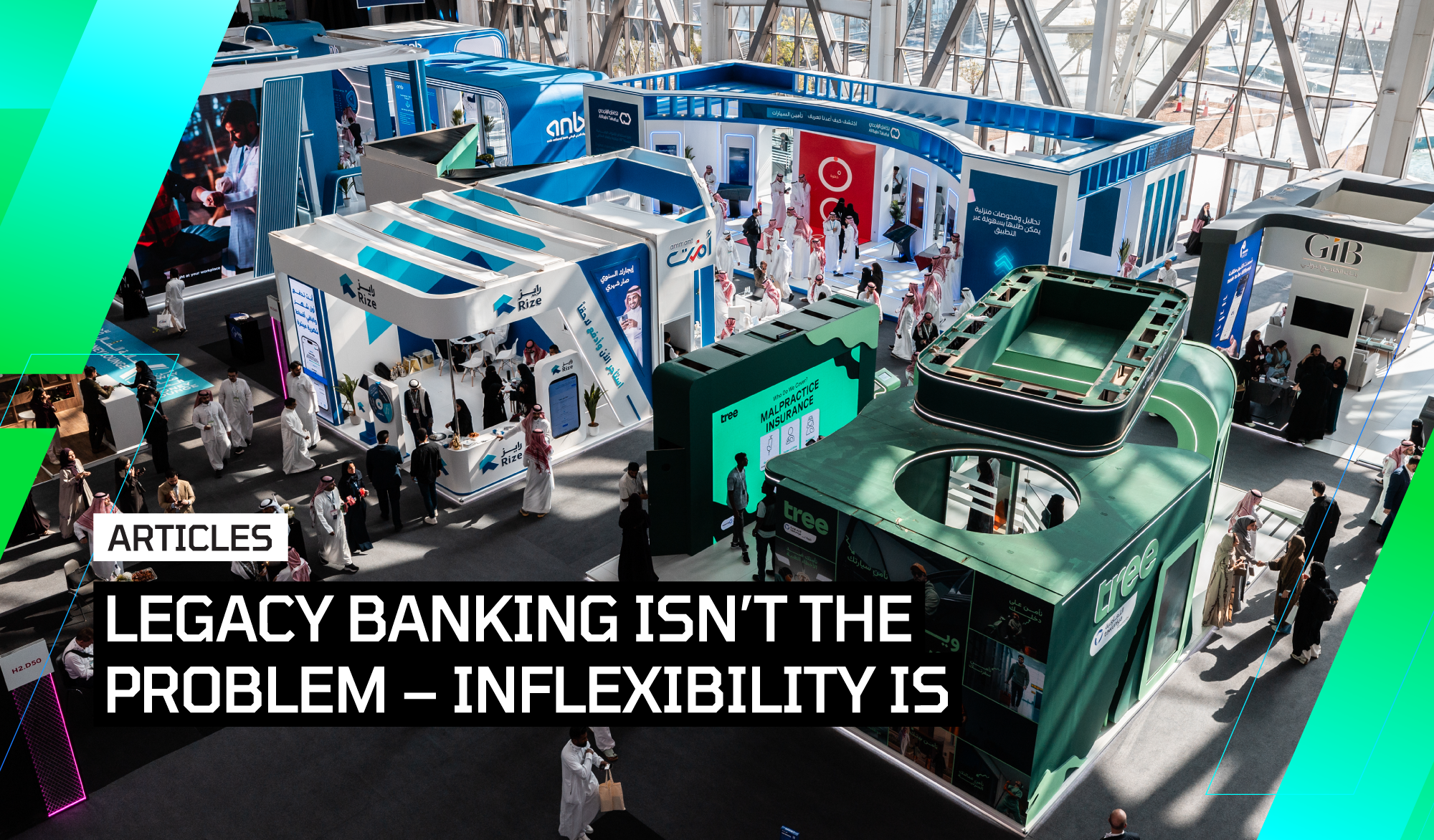
This came up in conversation frequently at Money20/20 Middle East 2025; because across the world, banks are profitable, digitally ambitious, and under more competitive pressure than at any point in the last two decades. The challenge in 2026 is whether legacy technology can change fast enough.
Globally, banking remains a powerful earnings engine. McKinsey’s 2025 review of global banking reports that the industry generated a record USD $1.2 trillion in net income in 2024.
McKinsey also argues that capital markets remain sceptical about banks’ long-term value creation potential relative to other industries – a sign that profitability alone isn’t convincing investors that banks are positioned for the next growth cycle.
This scepticism isn’t about outages. It’s about inflexibility; the operational drag that builds up when critical systems are hard to change, hard to integrate, and slow to adapt.
McKinsey warns that as third-party agents and AI reshape how consumers engage with money, banks that fail to reposition their business models could see global bank profit pools decline by $170 billion (9%) over the next decade, expressed in 2030 dollars.
That risk is rooted in whether your institution can launch, integrate, and iterate at the speed the market now expects.
This matters acutely in markets where banks are solid – and as a result, have more to lose from getting change wrong.
In the GCC, the IMF notes that capital adequacy ratios have remained strong and stable across GCC banking systems, well above prudent regulatory requirements (a useful reminder that much of the region’s banking strength is built on balance sheet resilience).
That strength creates room to modernise deliberately – but it doesn’t remove the competitive pressure to modernise quickly.
A 2025 SBS report (drawing on a Celent study) finds that 48% of banks in the Middle East and Africa are prioritising investment in digital banking platforms to modernise legacy systems.
And it’s not just a regional story. The same SBS report cites estimates for the global digital banking platform market growing from $11.56 billion in 2025 to $22.30 billion by 2030, reflecting sustained demand for more flexible banking infrastructure worldwide.
For many incumbents, full core replacement isn’t the only route to agility. A growing share of banks are pursuing progressive modernisation – separating customer-facing innovation from the system of record, and using layers (APIs, orchestration, modular services) to regain speed without destabilising the foundation.
That approach isn’t so headline-worthy. But it can restore optionality: the ability to launch faster, integrate partners more cleanly, and adapt operating models as AI and platforms shift customer expectations.
Arguably, the global banking industry doesn’t actually have a legacy problem. But it does have a flexibility problem.
In 2026, growth belongs to banks that can change repeatedly – and do it not just safely, but quickly enough to stay relevant as AI-driven agents and new distribution models reshape the economics of financial services.
Fintech is shifting from access to participation. Find out why ecosystems (not audiences) will define the next phase of growth in MENA and beyond.

Find out how Money20/20 Middle East is supporting Saudi Arabia’s fintech growth, accelerating Vision 2030 ambitions and aligning regulators, banks, startups and investors.
Fintech is shifting from access to participation. Find out why ecosystems (not audiences) will define the next phase of growth in MENA and beyond.
Find out how Money20/20 Middle East is supporting Saudi Arabia’s fintech growth, accelerating Vision 2030 ambitions and aligning regulators, banks, startups and investors.